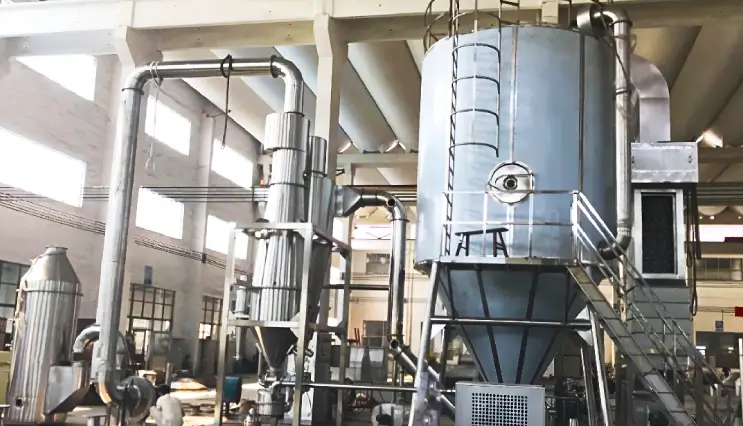
A Spray Dryer is an industrial drying system designed to convert liquid or slurry materials into fine powders using hot gas. The liquid feed is atomized into a heated drying chamber, allowing rapid evaporation of moisture and uniform particle formation. Spray Dryers are ideal for industries requiring high-quality powders with consistent particle size and low moisture content, such as food, pharmaceuticals, and chemicals.
A spray dryer is a widely used industrial equipment designed to convert a liquid feed—such as a solution, slurry, or suspension—into a dry powder in a single, rapid step. The principle of operation of a spray dryer is based on evaporative drying, where fine droplets of a liquid are sprayed into a stream of hot air inside a drying chamber. The small droplet size provides a large surface area for rapid heat and mass transfer, leading to almost instantaneous evaporation of moisture. As the moisture is removed, solid particles or powders are formed, which are collected from the drying chamber and separation units (cyclones or bag filters).
Thus, the working of a spray dryer is governed by convective heat and mass transfer — heat is transferred from the hot air to the liquid droplets, while moisture diffuses from the droplet interior to the surface and evaporates into the drying medium. The entire drying process occurs within a few seconds, allowing the production of fine, free-flowing, and uniform powders even from heat-sensitive materials such as milk, enzymes, pharmaceuticals, and flavorings.
The principle of spray drying involves three fundamental steps:
Because the droplet drying time is extremely short (1–10 seconds), spray drying can handle thermolabile or oxidation-sensitive materials that cannot be dried by other methods.
A spray dryer mainly consists of the following components:
The choice of atomizer depends on feed viscosity, required particle size, and product characteristics.
Instant moisture removal ensures high product quality.
Produces consistent, free-flowing powders.
Quick drying prevents thermal degradation.
Designed for large-scale, uninterrupted production.
Optimized air flow and atomization reduce energy consumption.
Rotary or nozzle atomizers for precise droplet formation.
Adjustable air temperature and flow for sensitive materials.
Ensures hygiene and corrosion resistance, especially for food and pharma.
Monitor temperature, feed rate, and air flow for consistent product quality.
For products requiring staged moisture removal and particle control.
































Unicoco, Indonesia was excited about the Coconut project, but through GEM we made this dream come true. GEM machines: dryers / screw conveyors / bleachers / graders, etc. they are absolutely good and require little maintenance. Also, we get 24×7 support from them in case we get stuck at any time.
GO FOR IT!!!
PT Unicoconut Industries Indonesia, Indonesia
Franklin Baker Company of the Philippines, in its continued effort to be the gold standard in processed coconut products, continues to partner with the best OEM suppliers for our manufacturing line requirements. One of them is GEM Forgings, which has been our trusted supplier of process equipment for our DC (desiccated coconut) dryers. We both value quality and service level in our business dealings.
Franklin Baker Company of the Philippines
Contact with us