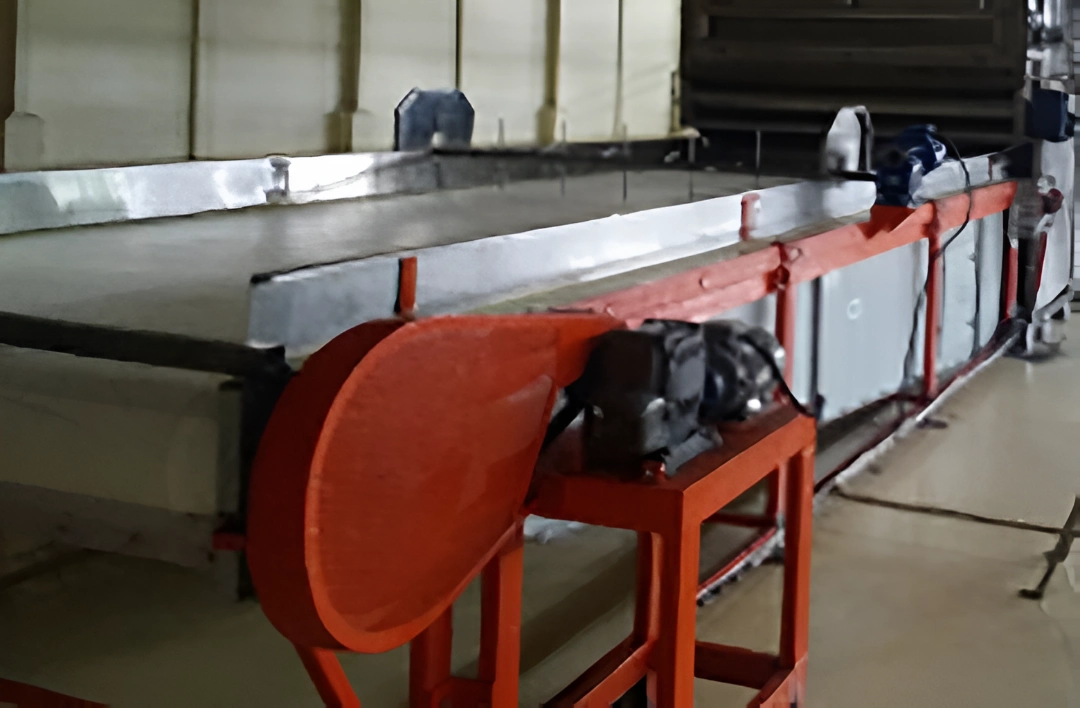
An Industrial Cooler is a continuous cooling system designed to reduce the temperature of hot or freshly processed materials quickly and efficiently. Using controlled air or water flow, the cooler ensures uniform heat removal without compromising product quality. It is widely used in food processing, chemical, pharmaceutical, and agro-industrial industries to handle high-temperature materials safely and efficiently.
An industrial cooler is a heat exchange device designed to remove heat from hot process materials, fluids, or gases and bring them to a desired lower temperature before further processing, packaging, or handling. The principle of operation of an industrial cooler is based on heat transfer — primarily convective and conductive heat exchange between a hot substance and a cooling medium such as air, water, or chilled fluid. The cooling medium absorbs heat from the product, reducing its temperature without altering its composition.
Industrial coolers are essential in various process industries such as food, chemical, pharmaceutical, fertilizer, cement, and metal processing, where materials exiting dryers, reactors, or kilns must be cooled to safe or usable temperatures. Cooling protects equipment downstream, maintains product quality, and allows for safe handling or packaging.
The basic principle of an industrial cooler is the transfer of heat from a hot product (solid, liquid, or gas) to a cooler medium through a surface or direct contact.
The temperature difference between the product and the cooling medium is the driving force for heat transfer. The rate of cooling depends on this temperature gradient, the surface area for heat transfer, and the heat transfer coefficient, which in turn depends on air velocity, turbulence, and physical properties of the materials involved.
The construction of an industrial cooler varies according to its type (rotary, fluid bed, shell-and-tube, or screw-type), but most coolers consist of the following essential components:
Quickly reduces material temperature, preserving quality.
Ensures consistent temperature across the product batch.
Optimized airflow or coolant systems minimize energy consumption.
Supports large-scale, uninterrupted production.
Maintains integrity of fragile or heat-sensitive products.
Transports materials evenly through the cooling zone.
Allows precise control over cooling rate.
Ensures uniform cooling for variable material types.
Suitable for hygienic applications in food and pharma.
Enhances heat transfer and prevents clumping.
Tracks temperature and airflow for consistent output.

































Unicoco, Indonesia was excited about the Coconut project, but through GEM we made this dream come true. GEM machines: dryers / screw conveyors / bleachers / graders, etc. they are absolutely good and require little maintenance. Also, we get 24×7 support from them in case we get stuck at any time.
GO FOR IT!!!
Owner and CEO
Franklin Baker Company of the Philippines, in its continued effort to be the gold standard in processed coconut products, continues to partner with the best OEM suppliers for our manufacturing line requirements. One of them is GEM Forgings, which has been our trusted supplier of process equipment for our DC (desiccated coconut) dryers. We both value quality and service level in our business dealings.
Franklin Baker Company of the Philippines
Contact with us