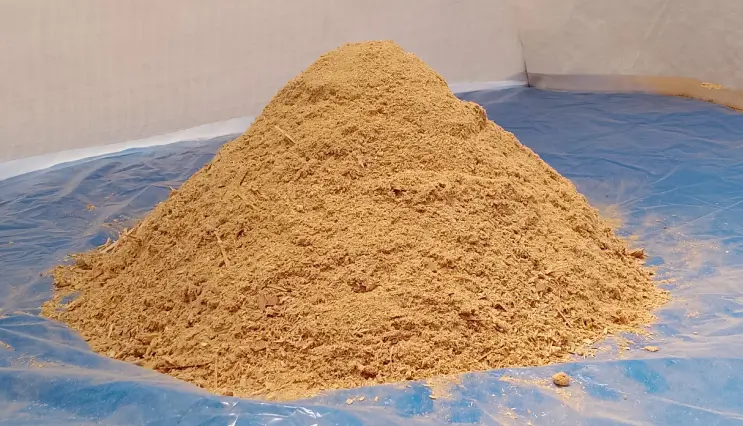
A Flash Dryer is a high-speed industrial dryer designed to rapidly remove moisture from fine powders, granules, and slurries. Material is fed into a hot air stream, which fluidizes and dries it almost instantly. This continuous drying system is ideal for industries requiring fast processing and uniform moisture content, such as chemicals, pharmaceuticals, food, and agro-industrial products.
The flash dryer operates on the principle of suspension drying or pneumatic drying, where moist feed particles are rapidly dried by direct contact with a stream of hot air or gas. The wet material, typically in the form of a slurry, paste, or wet powder, is dispersed into fine particles and introduced into a high-velocity hot air stream. The intense turbulence causes instantaneous heat and mass transfer, evaporating the surface moisture almost immediately. The dried particles are then separated from the drying air using a cyclone separator or bag filter, while the moist exhaust air is discharged.
The process relies primarily on convective heat transfer — the hot air transfers heat to the material, while the moisture diffuses and evaporates into the air stream. Because of the short residence time (a few seconds), flash drying minimizes thermal degradation and is ideal for heat-sensitive materials such as starch, proteins, food ingredients, and chemical powders.
A flash dryer is a vertical or slightly inclined cylindrical drying column through which hot air and product particles flow together. The main components are as follows:
The feed, usually a slurry or filter cake, is introduced into the hot air stream using a feed screw, rotary valve, or pneumatic injector. To improve drying efficiency, the feed may be disintegrated by a high-speed rotor, hammer mill, or disperser at the inlet, which breaks the wet mass into fine particles.
Ambient air is drawn by a centrifugal blower and heated to the desired temperature using steam coils, gas burners, or electric heaters. The inlet air temperature typically ranges from 150°C to 400°C, depending on the product and required drying rate.
The core of the dryer is the vertical drying duct or column, constructed from mild steel or stainless steel (SS304/SS316). The column is designed for high-velocity airflow (10–25 m/s), which suspends the particles and carries them through the dryer. The column length and diameter determine the residence time, which is typically 2–10 seconds.
At the base of the column, a distributor or hot air manifold introduces the heated air uniformly and at high velocity. Proper design ensures turbulent mixing and prevents backflow or dead zones.
The dried product is separated from the air in a cyclone separator, where centrifugal force causes solids to settle. Fine particles escaping the cyclone are captured by a bag filter or wet scrubber, ensuring dust-free exhaust and product recovery.
Dried powder collects at the bottom of the cyclone and is discharged through an airlock or rotary valve into a cooling conveyor or collection bin.
The exhaust air, containing evaporated moisture, is vented through ducts, often equipped with dampers and silencers. Some systems include heat recovery units for energy efficiency.
The system is equipped with temperature sensors, pressure indicators, and airflow controllers. A PLC–HMI control panel maintains stable inlet/outlet air temperatures and feed rates for uniform drying.
High-velocity hot air allows near-instant moisture removal.
Ensures consistent particle size and moisture content.
Suitable for large-scale, uninterrupted production.
Takes up less floor space compared to conventional dryers.
Optimized air and material flow reduces energy consumption.
Provides rapid drying and efficient heat transfer.
Adjustable feed and air velocity for precise drying.
Ensures hygiene and resistance to corrosion.
Maintains consistent drying conditions for heat-sensitive materials.
Monitors temperature, airflow, and feed rate for consistent output.
Facilitates easy maintenance and integration into production lines.
































Unicoco, Indonesia was excited about the Coconut project, but through GEM we made this dream come true. GEM machines: dryers / screw conveyors / bleachers / graders, etc. they are absolutely good and require little maintenance. Also, we get 24×7 support from them in case we get stuck at any time.
GO FOR IT!!!
PT Unicoconut Industries Indonesia, Indonesia
Franklin Baker Company of the Philippines, in its continued effort to be the gold standard in processed coconut products, continues to partner with the best OEM suppliers for our manufacturing line requirements. One of them is GEM Forgings, which has been our trusted supplier of process equipment for our DC (desiccated coconut) dryers. We both value quality and service level in our business dealings.
Franklin Baker Company of the Philippines
Contact with us