
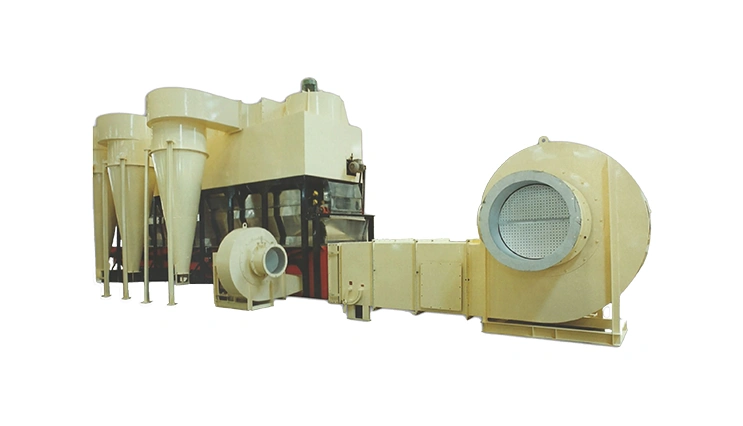
A Vibratory Fluid Bed Dryer is an advanced industrial drying system designed to efficiently dry granules, powders, and small particulate materials. It combines fluidization and vibratory motion to ensure uniform heat transfer, rapid moisture removal, and consistent product quality. Ideal for pharmaceuticals, chemicals, food processing, and agro-industrial applications, this dryer ensures high throughput while maintaining product integrity.
A Vibratory Fluid Bed Dryer (VFBD) operates on the combined principles of fluidization and vibration-assisted drying. The process is based on the transfer of heat and mass between a stream of hot air and moist granular or particulate material, enhanced by mechanical vibration. When a controlled stream of hot air passes upward through a bed of moist particles at a sufficient velocity, the particles become suspended and behave like a fluid — a state known as fluidization. In this condition, each particle is surrounded by hot air, resulting in efficient and uniform heat transfer. Moisture within the particles evaporates rapidly due to the high contact surface area and is carried away by the exhaust air.
In a vibratory fluid bed dryer, the bed of material is mounted on a vibrating base, and the vibrations help to improve fluidization by preventing channeling, agglomeration, and dead zones. The vibration also assists in progressive movement of the material along the dryer’s length, allowing continuous operation. This combination of fluidization and vibration provides gentle yet highly effective drying, making the VFBD ideal for granular, crystalline, and heat-sensitive materials such as food grains, pharmaceuticals, fertilizers, and chemicals.
The working principle of the VFBD involves three simultaneous actions:
The hot air, supplied through a perforated distributor plate, flows upward through the vibrating bed. As the material becomes fluidized, moisture from the particle surface evaporates, and internal moisture diffuses outward. The dry, free-flowing product gradually moves toward the discharge end due to the combined effect of air velocity and vibration.
A Vibratory Fluid Bed Dryer is typically a rectangular or circular stainless steel unit designed for continuous drying of granular or crystalline materials. The major components and their functions are described below:
The main body of the dryer is a rectangular vibrating trough made of stainless steel (SS304 or SS316L). The chamber contains a perforated distributor plate or screen deck that supports the product bed. The plate allows uniform distribution of hot air across the bed while holding the solid material above. The chamber is enclosed with insulated sidewalls and a removable top cover fitted with observation windows, inspection ports, and exhaust outlets.
Beneath the perforated bed is an air plenum chamber, which evenly distributes the drying air through the perforations. The plenum is designed to maintain uniform pressure and flow across the entire bed surface, ensuring consistent fluidization.
The drying air is heated to the desired temperature using steam coils, gas burners, or electrical heaters and then blown into the plenum chamber by a centrifugal blower. The air temperature typically ranges between 60°C and 140°C, depending on the material’s thermal sensitivity. The airflow rate and temperature are controlled to maintain stable fluidization without blowing particles out of the bed.
The entire drying chamber is mounted on spring isolators or rubber dampers and vibrated by unbalanced motors or electromagnetic drives. The vibration is typically linear or elliptical, with a frequency range of 10–25 Hz and amplitude of 1–5 mm. This motion keeps the particles in a dynamic state of movement, preventing sticking and ensuring even exposure to the hot air. The vibration also causes the material to move gradually forward along the length of the bed, enabling continuous drying and discharge.
The feed system delivers the moist material onto the fluidized bed through a controlled feeder such as a screw feeder or vibratory chute. As the material travels along the bed, it passes through zones of decreasing moisture content. The dried product is discharged at the far end through an outlet chute or rotary valve, which maintains the air seal and regulates product flow.
The moist exhaust air exits the dryer through an outlet duct located above the bed. A cyclone separator or bag filter is used to capture entrained fine particles, and the clean air is then vented or partially recirculated. The system may also include a heat recovery unit to improve energy efficiency.
Modern VFBDs are equipped with temperature, airflow, and vibration control systems. A PLC–HMI panel regulates inlet air temperature, bed pressure drop, and vibration frequency to maintain optimal drying conditions. Safety interlocks protect against over-temperature or vibration imbalance.
Vibratory motion ensures even exposure to hot air, preventing hotspots.
Fluidization accelerates drying, reducing process time.
Minimizes degradation of heat-sensitive materials.
Suitable for continuous large-scale production.
Optimized airflow and heat distribution reduce energy consumption.
Combines fluid bed drying with controlled vibration for superior heat transfer.
Allows precise drying of materials with varying moisture content.
Ensures hygiene and corrosion resistance, particularly in food and pharma applications.
Optimizes drying for different material types.
Monitors temperature, airflow, and vibration for consistent output.
Facilitates maintenance and integration into existing production lines.



































Unicoco, Indonesia was excited about the Coconut project, but through GEM we made this dream come true. GEM machines: dryers / screw conveyors / bleachers / graders, etc. they are absolutely good and require little maintenance. Also, we get 24×7 support from them in case we get stuck at any time.
GO FOR IT!!!
PT Unicoconut Industries Indonesia, Indonesia
Franklin Baker Company of the Philippines, in its continued effort to be the gold standard in processed coconut products, continues to partner with the best OEM suppliers for our manufacturing line requirements. One of them is GEM Forgings, which has been our trusted supplier of process equipment for our DC (desiccated coconut) dryers. We both value quality and service level in our business dealings.
Franklin Baker Company of the Philippines
I have heard about the progress of your drying equipment and our staff was amazed at its performance, which is above average compared to the old dryers we have.
I have advised the plant managers at both plants to contact you about upgrading our existing dryers to meet the specifications of the new one.
Therefore, I would like to congratulate you on the new technology that you have integrated into the drying process equipment.
Peter Paul Philippine Corporation, Philippines
Contact with us