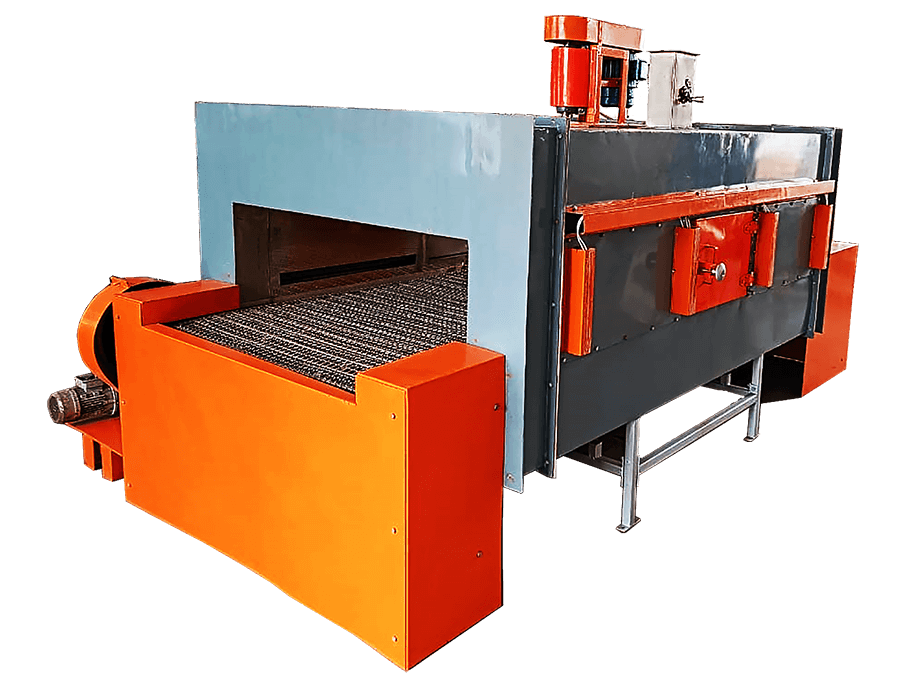
A Tunnel Oven is an industrial continuous oven designed to bake, dry, or heat-treat products on a conveyor system as they pass through a heated chamber. This high-capacity system ensures uniform temperature distribution, precise process control, and consistent product quality. Ideal for food, chemical, pharmaceutical, and other industrial applications, Tunnel Ovens offer efficiency and reliability for large-scale production.
A tunnel oven is a type of continuous heating and drying system used extensively in the food, chemical, ceramic, and metallurgical industries for baking, curing, or drying products. The principle of operation of a tunnel oven is based on heat transfer by conduction, convection, and radiation. The product is placed on a moving conveyor belt or trays, which travel slowly through a long, enclosed heating chamber (the “tunnel”). As it moves through different temperature zones, it is heated uniformly by hot air, steam, or radiant energy until it reaches the desired temperature or moisture content.
The process relies on the controlled circulation of heated air or gases to ensure efficient and uniform heat transfer to the product. The temperature, air velocity, and residence time are carefully regulated to achieve consistent quality. In essence, a tunnel oven functions as a continuous process oven, providing steady throughput with minimal manual handling and high thermal efficiency.
The working principle of a tunnel oven is straightforward:
Products to be baked, cured, or dried are loaded onto a conveyor belt, mesh band, or trolleys, which move at a controlled speed through a thermally insulated tunnel divided into several heating zones. Each zone maintains a specific temperature and airflow pattern depending on the stage of the process.
Heat is transferred to the product primarily through convection (hot air flow), conduction (contact with trays or belt), and radiation (infrared or gas-fired burners). As the product progresses through the oven, it absorbs heat gradually and uniformly. The moisture or volatile components evaporate and are removed by the exhaust air system. By adjusting conveyor speed and zone temperatures, the desired baking, drying, or curing profile can be achieved.
A tunnel oven consists of several key components designed to ensure uniform heating, efficient operation, and continuous processing:
Supports large-scale production without interruption.
Ensures consistent temperature across all products.
Optimized airflow and heating systems reduce energy consumption.
Allows precise control over temperature, speed, and residence time.
Durable construction ensures long-term reliable operation.
Moves products consistently through the oven for even heat exposure.
Different zones can be independently controlled for optimal baking or drying.
Ensures hygiene and corrosion resistance, especially in food applications.
Adjusts residence time for different product types.
Monitors temperature, airflow, and speed for precise process management.
For applications requiring controlled moisture during processing.

































Unicoco, Indonesia was excited about the Coconut project, but through GEM we made this dream come true. GEM machines: dryers / screw conveyors / bleachers / graders, etc. they are absolutely good and require little maintenance. Also, we get 24×7 support from them in case we get stuck at any time.
GO FOR IT!!!
PT Unicoconut Industries Indonesia, Indonesia
Franklin Baker Company of the Philippines, in its continued effort to be the gold standard in processed coconut products, continues to partner with the best OEM suppliers for our manufacturing line requirements. One of them is GEM Forgings, which has been our trusted supplier of process equipment for our DC (desiccated coconut) dryers. We both value quality and service level in our business dealings.
Franklin Baker Company of the Philippines
Contact with us