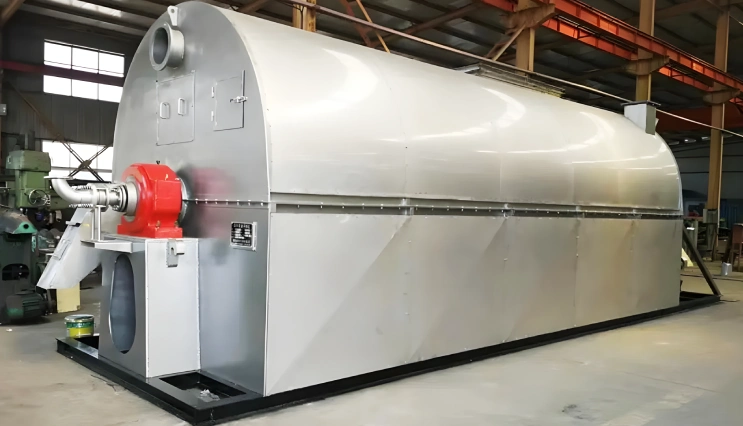
The wet feed which has free flowing form is made to work over the rotating bundle of heated tubes. Due to radiation and conduction effects, the moisture is evaporated and the product
becomes progressively dry as it travels across the dryer and reaches final moisture level at the discharge point. Due to effective turbulence the solids are dried uniformly.
A Rotary Tube Bundle Dryer (RTBD) is a type of indirect heat transfer dryer used extensively in the chemical, food, fertilizer, and mineral industries for drying free-flowing and granular materials. It operates on the principle of conduction, where heat is transferred indirectly from steam (or another heating medium) flowing through a bundle of rotating tubes to the wet material surrounding them. The moisture from the product evaporates without the material coming into direct contact with the heating medium, making it ideal for heat-sensitive, dusty, or contaminable products.
The principle of a rotary tube bundle dryer is based on indirect heat transfer by conduction and mild convection.
Since there is no direct contact between product and heating medium, the process is clean, controlled, and suitable for heat-sensitive or oxidizable materials.
A rotary tube bundle dryer consists of the following major components:
The main body of the dryer is a hollow, cylindrical shell that rotates slowly around its axis. The shell is slightly inclined (1°–5°) to allow the material to move gradually from the feed end to the discharge end by gravity. It is fabricated from carbon steel or stainless steel (SS 304 / SS 316), depending on the product characteristics. The shell is usually steam-jacketed externally to prevent heat loss and maintain consistent temperature.
The length-to-diameter ratio typically ranges from 4:1 to 8:1, and the drum rotates at a speed of 2–10 rpm, driven by a motor and gear system.
The heart of the dryer is the tube bundle, which consists of hundreds of small-diameter tubes (typically 25–75 mm OD) fixed at both ends to tube plates and mounted inside the rotating shell. Steam (or another heating medium) flows through these tubes.
Steam is supplied through a rotary joint to one end of the tube bundle. The steam flows through the tubes, condenses on the inner walls, and releases latent heat to the material outside. The condensate formed is removed through a condensate collection header and discharged via the same rotary joint or a separate outlet.
A steam trap is installed to ensure continuous condensate removal and maintain maximum heat transfer efficiency.
Although the dryer works on indirect heating, a small amount of air or inert gas is introduced to carry away evaporated moisture vapours. The moist air exits through an exhaust duct connected to a cyclone separator or bag filter to recover fine particles before venting. In some cases, vapour condensers are used when solvent recovery is required.
The drum is mounted on support rollers or trunnions and rotated by an electric motor with a gearbox via a chain, belt, or girth gear drive. The drive system is designed to handle the combined load of the drum and the tube bundle while maintaining smooth rotation.
The entire outer shell is insulated with glass wool or mineral wool and covered with a protective steel sheet to minimize heat loss and ensure safe operation.
The RTBD is equipped with pressure gauges, thermocouples, condensate flow meters, and temperature controllers to regulate the steam pressure, drum speed, and feed rate.
Modern systems are automated using PLC–HMI panels for precision control, data logging, and safety interlocks.
Large internal heat-transfer area (steam-heated tubes) gives low steam consumption per kg of evaporation.
No direct contact with flue gas → clean product, low contamination, minimal oxidation/odor.
Cascading bed + lifting flights/tubes ensure even residence time; good for sticky or temperature-sensitive materials.
Little process air required; easy to capture fines; simpler pollution control.
Big evaporation capacity in a relatively small shell.
Simple drive, few moving parts inside the shell; condensate recovery reduces utilities cost.
Handles pasty, fibrous, granular, and crystalline feeds.
Closed/vented system with condensate sealing, scrubber integration.
Modular tube bundles; tolerant to feed rate/moisture fluctuations.
with low maintenance.
requirements.
giving the reduced output of waste air.
& robust Construction.
Operation.
drying for high quality products to avoid losses of vitamins, nutrients and taste change.

































Unicoco, Indonesia was excited about the Coconut project, but through GEM we made this dream come true. GEM machines: dryers / screw conveyors / bleachers / graders, etc. they are absolutely good and require little maintenance. Also, we get 24×7 support from them in case we get stuck at any time.
GO FOR IT!!!
PT Unicoconut Industries Indonesia, Indonesia
Franklin Baker Company of the Philippines, in its continued effort to be the gold standard in processed coconut products, continues to partner with the best OEM suppliers for our manufacturing line requirements. One of them is GEM Forgings, which has been our trusted supplier of process equipment for our DC (desiccated coconut) dryers. We both value quality and service level in our business dealings.
Franklin Baker Company of the Philippines
Contact with us