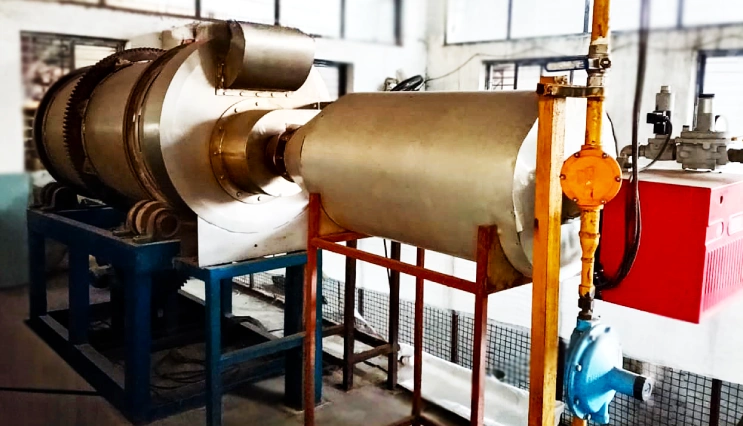
Hot air at desired temperature and flow rate is made to flow through the tumbling bed of wet feed. The wet material gets progressively dried to the final level of desired moisture and exits at the discharge end. The humid air carrying moisture transferred from the drying material is exhausted via a dust separator. Widely used equipment for granular and free flowing material. Rotation of dryer promotes intimate mixing and fresh surfaces are constantly exposed to the incoming hot gases resulting in uniform drying.
A Rotary Louvre Dryer (also known as a Louver Dryer) is a direct-contact type rotary dryer designed for drying free-flowing, granular, and crystalline materials such as minerals, fertilizers, grains, and chemicals. It is similar in appearance to a rotary cascade dryer, but differs in its internal construction — instead of lifting flights, it contains stationary or semi-stationary angled louvres (or louvers) fitted along the periphery inside the drum.
It operates on the principle of direct heat transfer by convection, where hot air or gas passes through the louvres and the bed of material as it moves through the rotating drum. The louvre arrangement ensures that the material is continuously turned, mixed, and aerated, promoting uniform heat transfer and efficient drying.
The principle of a rotary louvre dryer is based on convective heat transfer between hot air (or flue gas) and moist solids that are continuously agitated inside a rotating, inclined cylinder fitted with louvres.
This louvre design provides controlled agitation and uniform air distribution, resulting in more efficient drying than a plain rotary drum and gentler handling than a flighted cascade dryer.
A Rotary Louvre Dryer consists of the following main components:
The dryer consists of a cylindrical shell that is slightly inclined (1°–5°) from the horizontal, allowing the material to move gradually from the feed end to the discharge end by gravity.
The most distinctive feature of the rotary louvre dryer is the series of fixed or adjustable louvres fitted inside the drum.
This louvre arrangement ensures that the material is uniformly distributed and continuously agitated, avoiding dead zones and overheating.
The wet material is introduced at the higher end of the drum through a feed chute or screw conveyor. The feed rate can be controlled using a rotary valve or variable-speed feeder to maintain a steady material flow.
The drying medium (hot air or flue gas) is generated by a furnace, gas burner, or hot air generator and introduced into the drum through an air distributor or duct.
Typical inlet air temperatures range from 150°C to 600°C, depending on the product.
The moisture-laden exhaust air exits from the opposite end of the drum and passes through a dust collection system, such as a cyclone separator, bag filter, or scrubber, to remove entrained particles before being released to the atmosphere.
The dried material exits through a discharge chute or screw conveyor at the lower end of the drum. In some cases, a rotary airlock valve is installed to prevent air leakage while allowing continuous discharge.
The drum is rotated by an electric motor with a reduction gearbox, using a chain drive, belt drive, or girth gear. A variable frequency drive (VFD) is often provided to control drum speed and optimize drying time.
The outer surface of the drum is insulated with mineral wool or glass wool and covered with a sheet metal cladding to minimize heat loss and ensure operator safety.
A rotary louvre dryer is equipped with temperature sensors, airflow meters, and pressure gauges at both ends.
Modern systems are automated with PLC–HMI control panels that regulate inlet temperature, drum speed, and air velocity for consistent drying and energy efficiency.
due to direct air–solid contact.
ideal for granular and friable materials.
because of continuous mixing by louvres.
and robust construction.
suitable for large-scale industrial drying.
or low-grade flue gases.
through louvre angle and drum speed control.
surface and bound moisture in the drying solids.
of drying solids avoiding attrition.
action ensures uniform drying of all the particles
operation
efficiency
dusting.
electrical power.
breakage of crystal.
































Unicoco, Indonesia was excited about the Coconut project, but through GEM we made this dream come true. GEM machines: dryers / screw conveyors / bleachers / graders, etc. they are absolutely good and require little maintenance. Also, we get 24×7 support from them in case we get stuck at any time.
GO FOR IT!!!
PT Unicoconut Industries Indonesia, Indonesia
Franklin Baker Company of the Philippines, in its continued effort to be the gold standard in processed coconut products, continues to partner with the best OEM suppliers for our manufacturing line requirements. One of them is GEM Forgings, which has been our trusted supplier of process equipment for our DC (desiccated coconut) dryers. We both value quality and service level in our business dealings.
Franklin Baker Company of the Philippines
Contact with us