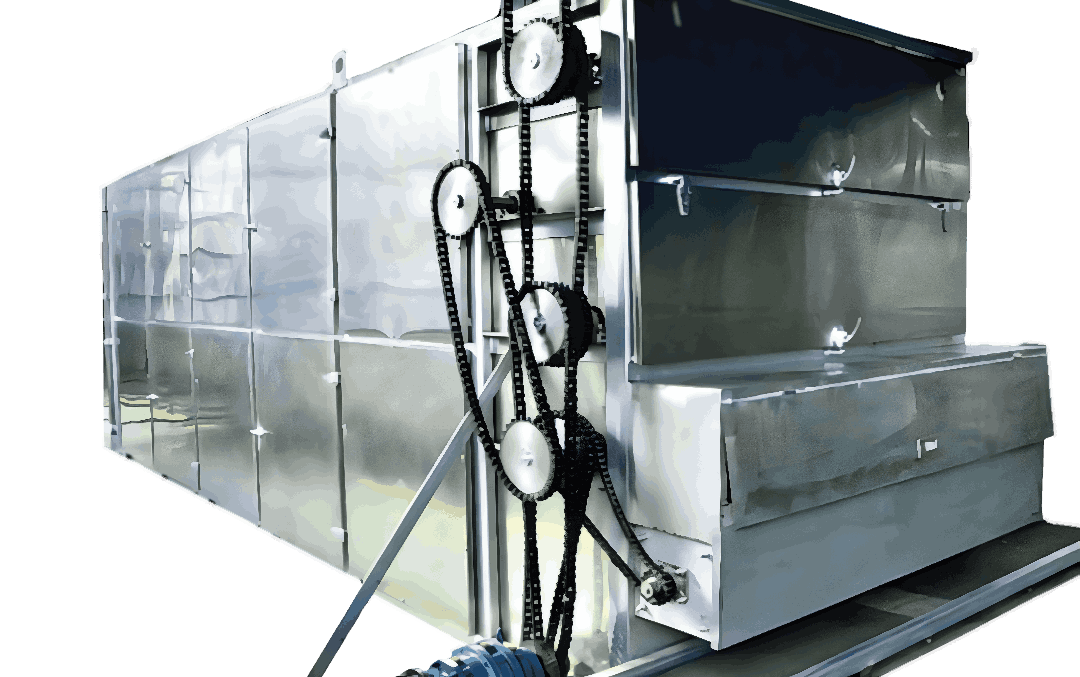
A Multi-Pass (Multi-Stage) Conveyor Dryer is a compact, stacked belt-drying system that multiplies residence time—and capacity—without expanding floor space. Product travels across two to five vertically stacked passes, each with independent control of temperature, airflow, humidity, and belt speed. The staged profile delivers tight end-moisture, gentle handling of sticky or fragile materials, and high evaporation per square meter—ideal for cereals, food ingredients, pet food, chemicals, biomass, and rubber products.
The multi pass mesh belt dryer, also known as a multi-layer belt dryer, operates on the principle of continuous convective drying. In this process, hot air is passed through a moving bed of material that is spread uniformly on a perforated or mesh conveyor belt. The hot air transfers heat to the wet material, causing the moisture to evaporate from its surface and diffuse outward from within the particles. The moisture-laden air is then exhausted or recirculated, and fresh hot air is continuously supplied to maintain the desired drying conditions. The drying process relies primarily on forced convection, where heated air flows through the material layers either from top to bottom or bottom to top, depending on the design.
In a multi-layer belt dryer, several mesh belts are arranged one above the other within a closed, thermally insulated drying chamber. The material moves progressively from the top layer to the bottom layer, passing through zones of controlled temperature and airflow. As the material travels along each belt, it gradually loses moisture, ensuring uniform drying by the time it exits from the bottom discharge conveyor. The multi-layer configuration allows for a large drying area in a compact footprint, making the design energy-efficient and suitable for continuous production of bulk materials such as food products, chemicals, biomass, and sludge.
The fundamental principle of a mesh belt dryer is the transfer of heat and mass between hot air and moist material. Moisture removal occurs in two steps:
The rate of drying depends on factors such as air temperature, humidity, velocity, air flow direction, bed depth, residence time, and product characteristics. Typically, the drying process is divided into multiple temperature zones, allowing the product to experience high temperature initially for rapid surface drying, followed by moderate temperatures in subsequent zones to avoid overheating or case hardening.
A multi-layer mesh belt dryer is a modular, continuous-type drying system, generally constructed in stainless steel or carbon steel depending on the application (food-grade or industrial). It consists of the following main components:
stacked passes multiply residence length and throughput.
transfer-stage mixing + bed leveling deliver uniform moisture and color.
zone-wise temperature, airflow, and belt speed enable product-specific profiles.
high recirculation, targeted exhaust, and optional heat recovery lower OPEX vs. trays/rotary.
ideal for sticky, sugar- or oil-rich, fragile, or thicker beds.
gentle conveying minimizes fines and product damage.
clean interiors, CIP readiness, and self-clearing layouts reduce downtime.
robust drives, perforated belts, and industrial-grade components.
with independent VFD belt speeds and multi-zone temperature/airflow per pass
with engineered air plates for across-bed temperature/air uniformity
co-current, counter-current, or mixed through-air/over-air with adjustable dampers
fresh-air make-up, exhaust control, and dew-point monitoring
dewatering press, granulator/shredder, grinder/sifter, metal detector, fines recapture
section at discharge for pack stability
PLC-HMI/SCADA, recipe library, trending, alarms, remote diagnostics
over-temp cut-outs, flame supervision (gas), fire detection/mist, explosion relief/venting
































Unicoco, Indonesia was excited about the Coconut project, but through GEM we made this dream come true. GEM machines: dryers / screw conveyors / bleachers / graders, etc. they are absolutely good and require little maintenance. Also, we get 24×7 support from them in case we get stuck at any time.
GO FOR IT!!!
PT Unicoconut Industries Indonesia, Indonesia
Franklin Baker Company of the Philippines, in its continued effort to be the gold standard in processed coconut products, continues to partner with the best OEM suppliers for our manufacturing line requirements. One of them is GEM Forgings, which has been our trusted supplier of process equipment for our DC (desiccated coconut) dryers. We both value quality and service level in our business dealings.
Franklin Baker Company of the Philippines
Contact with us