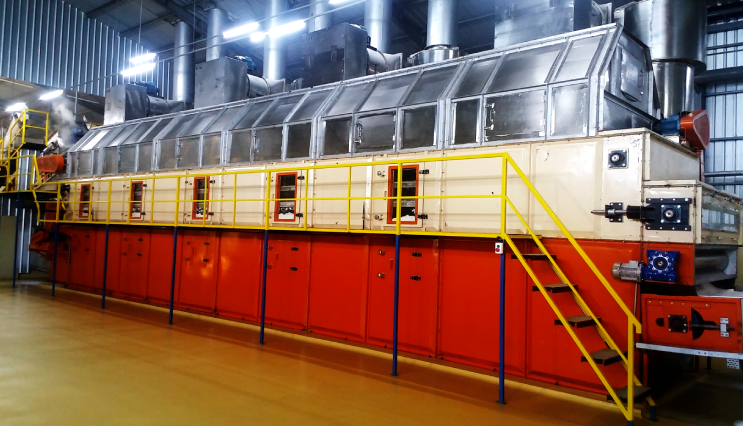
A Mesh Belt Dryer is an industrial conveyorized drying system designed to continuously dry bulk materials, powders, or granules with high efficiency. Materials are transported on a mesh belt through a controlled heated airflow, allowing uniform moisture removal while maintaining product quality. This equipment is ideal for food, pharmaceuticals, chemicals, and agro-industrial applications requiring gentle, precise, and continuous drying.
The mesh belt dryer, also known as a multi-layer belt dryer, operates on the principle of continuous convective drying. In this process, hot air is passed through a moving bed of material that is spread uniformly on a perforated or mesh conveyor belt. The hot air transfers heat to the wet material, causing the moisture to evaporate from its surface and diffuse outward from within the particles. The moisture-laden air is then exhausted or recirculated, and fresh hot air is continuously supplied to maintain the desired drying conditions. The drying process relies primarily on forced convection, where heated air flows through the material layers either from top to bottom or bottom to top, depending on the design.
In a multi-layer belt dryer, several mesh belts are arranged one above the other within a closed, thermally insulated drying chamber. The material moves progressively from the top layer to the bottom layer, passing through zones of controlled temperature and airflow. As the material travels along each belt, it gradually loses moisture, ensuring uniform drying by the time it exits from the bottom discharge conveyor. The multi-layer configuration allows for a large drying area in a compact footprint, making the design energy-efficient and suitable for continuous production of bulk materials such as food products, chemicals, biomass, and sludge.
The fundamental principle of a mesh belt dryer is the transfer of heat and mass between hot air and moist material. Moisture removal occurs in two steps:
The rate of drying depends on factors such as air temperature, humidity, velocity, air flow direction, bed depth, residence time, and product characteristics. Typically, the drying process is divided into multiple temperature zones, allowing the product to experience high temperature initially for rapid surface drying, followed by moderate temperatures in subsequent zones to avoid overheating or case hardening.
A multi-layer mesh belt dryer is a modular, continuous-type drying system, generally constructed in stainless steel or carbon steel depending on the application (food-grade or industrial). It consists of the following main components:
Supports uninterrupted production, increasing efficiency.
Ensures even moisture removal across the material bed.
Optimized airflow reduces energy consumption.
Prevents damage to fragile or heat-sensitive products.
Durable construction ensures long-term reliability.
Provides continuous material movement and even exposure to hot air.
Enables precise control of drying conditions.
Ideal for hygienic applications in food and pharmaceuticals.
Controls drying time for different materials.
Enhances energy efficiency by reusing heated air.
Easy to install, maintain, and integrate with existing production lines.































Unicoco, Indonesia was excited about the Coconut project, but through GEM we made this dream come true. GEM machines: dryers / screw conveyors / bleachers / graders, etc. they are absolutely good and require little maintenance. Also, we get 24×7 support from them in case we get stuck at any time.
GO FOR IT!!!
PT Unicoconut Industries Indonesia, Indonesia
Franklin Baker Company of the Philippines, in its continued effort to be the gold standard in processed coconut products, continues to partner with the best OEM suppliers for our manufacturing line requirements. One of them is GEM Forgings, which has been our trusted supplier of process equipment for our DC (desiccated coconut) dryers. We both value quality and service level in our business dealings.
Franklin Baker Company of the Philippines
Contact with us