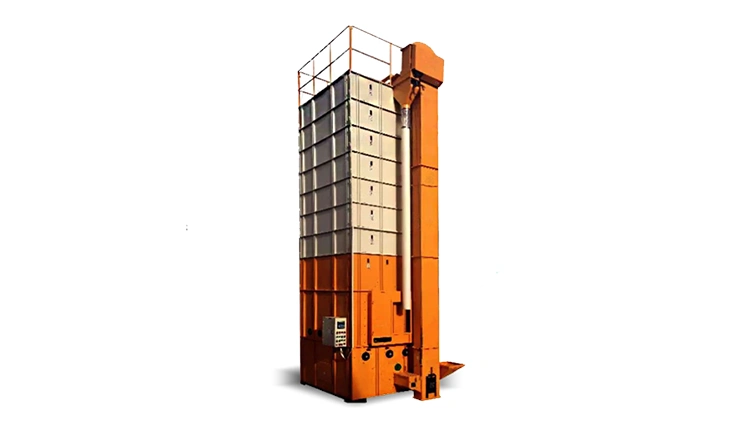
A Grain Dryer is an advanced drying system engineered to reduce the moisture content of harvested grains, ensuring safe storage and improved product quality. It operates on a controlled flow of hot air through the grain bed, providing uniform drying while preserving the grain’s nutritional and physical characteristics. This system is ideal for processing crops such as rice, wheat, corn, barley, and pulses.
A grain dryer is an equipment used to reduce the moisture content of grains such as paddy, wheat, maize, barley, and pulses to safe storage levels. The fundamental principle of grain drying is based on the simultaneous transfer of heat and mass between the drying air and the moist grain. When hot air comes into contact with the grain, heat is transferred from the air to the grain surface, causing moisture within the grain to evaporate. The resulting water vapour diffuses from the inner layers of the grain to the surface and is carried away by the moving air. This process continues until the grain reaches its equilibrium moisture content (EMC) with the drying air, beyond which no further drying occurs. The drying rate depends on air temperature, velocity, relative humidity, and contact time, as well as the grain’s initial moisture, size, and type.
Grain drying can be accomplished through natural (ambient-air) drying or artificial (mechanical) drying. In natural drying, ambient air is blown through the grain for extended periods, while in artificial dryers, air is heated to accelerate moisture removal. Most modern dryers operate on the convective drying principle, where hot air passes through a bed or column of grains, transferring heat and removing evaporated moisture simultaneously.
A grain dryer consists of several major components, designed to ensure uniform heating, controlled airflow, and safe operation during drying. The construction varies slightly depending on whether it is a batch-type, continuous-flow, or recirculatory dryer, but the basic components are as follows:
The main part of the dryer is the drying chamber, which holds the grain during the drying process. It is generally a cylindrical or rectangular tower made of mild steel or stainless steel sheets, perforated to allow uniform air distribution. The chamber may be designed for batch operation, where a fixed quantity of grain is dried at a time, or continuous operation, where grain flows steadily downward by gravity. The height and cross-sectional area of the chamber are designed to provide the required residence time for moisture reduction.
The drying air is heated using steam coils, electrical heaters, or fuel burners (LPG, diesel, biomass, or natural gas). The air temperature typically ranges from 40°C to 110°C, depending on the type of grain and desired drying rate. For heat-sensitive grains like paddy or maize seed, lower temperatures (40–60°C) are used to prevent cracking or loss of germination capacity. The heated air is directed into the drying chamber through ducts or plenum chambers.
A centrifugal or axial flow blower supplies the necessary airflow through the grain bed. The blower ensures adequate air velocity to carry away evaporated moisture while maintaining even temperature distribution. The fan speed and airflow rate can be adjusted depending on grain depth and drying stage.
The hot air enters the dryer through perforated sheets, ducts, or false floors to ensure uniform air distribution throughout the grain bed. Proper air distribution is critical to achieve uniform drying, as poor circulation can lead to over-dried or under-dried zones. Some dryers use a cross-flow system (air flows across the grain), while others use a mixed-flow or counter-flow arrangement for improved uniformity.
The grain feeding system consists of hoppers, conveyors, or bucket elevators that load the grain into the drying chamber. In continuous-flow dryers, grains move downward slowly through gravity while drying air passes across or upward through the bed. The discharge system at the bottom may include a screw conveyor, rotary valve, or discharge gate, which controls the flow rate of dried grain out of the dryer.
Modern dryers are equipped with temperature and moisture sensors that monitor the air and grain conditions during drying. These sensors feed data to a PLC or microcontroller-based control system, which automatically regulates the drying air temperature, fan speed, and discharge rate to maintain the desired final moisture content (usually 12–14% for safe storage).
After drying, grains are often hot and fragile, requiring a short cooling period before storage. Many dryers have an integrated cooling zone, where ambient air is blown through the dried grain to reduce its temperature to within 5°C of ambient conditions. This prevents condensation and spoilage in storage.
Dust Collection and Safety Features:
Since fine dust particles can be generated during drying, dryers include cyclone separators or dust filters to reduce emissions. Safety features such as temperature cut-offs, flame arrestors, and emergency vents are provided to prevent overheating or fire hazards.
Effectively removes excess moisture, preventing mold growth and grain deterioration.
Designed for optimal heat utilization, reducing energy consumption and operating costs.
Ensures uniform moisture reduction throughout the batch.
Enhances product stability and longevity during storage.
Minimizes cracking and breakage of grains, preserving quality and market value.
Enables precise regulation for different grain types.
Ensures accurate drying levels for consistent output.
Incorporates heat recovery and insulation for reduced energy use.
Easy to install, expand, and maintain.
Made from corrosion-resistant metals for long-term durability.

































Unicoco, Indonesia was excited about the Coconut project, but through GEM we made this dream come true. GEM machines: dryers / screw conveyors / bleachers / graders, etc. they are absolutely good and require little maintenance. Also, we get 24×7 support from them in case we get stuck at any time.
GO FOR IT!!!
PT Unicoconut Industries Indonesia, Indonesia
Franklin Baker Company of the Philippines, in its continued effort to be the gold standard in processed coconut products, continues to partner with the best OEM suppliers for our manufacturing line requirements. One of them is GEM Forgings, which has been our trusted supplier of process equipment for our DC (desiccated coconut) dryers. We both value quality and service level in our business dealings.
Franklin Baker Company of the Philippines
I have heard about the progress of your drying equipment and our staff was amazed at its performance, which is above average compared to the old dryers we have.
I have advised the plant managers at both plants to contact you about upgrading our existing dryers to meet the specifications of the new one.
Therefore, I would like to congratulate you on the new technology that you have integrated into the drying process equipment.
Peter Paul Philippine Corporation, Philippines
Contact with us