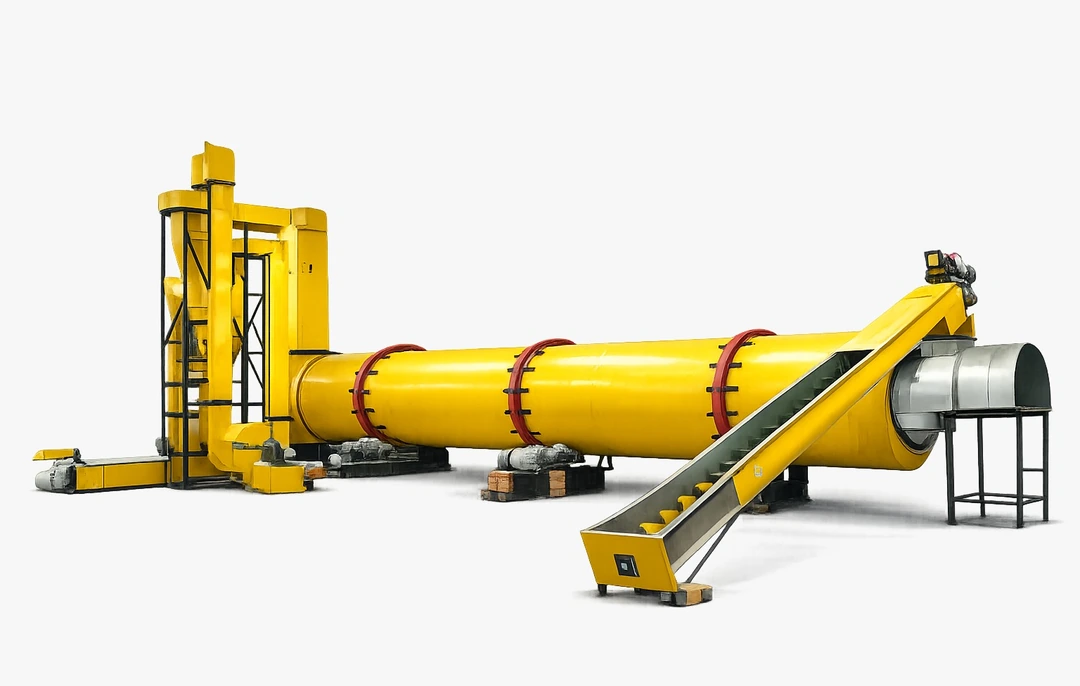
A Rotary Dryer is a continuous industrial drying system designed for large-scale drying of bulk solids, granules, powders, and biomass. Material is fed into a rotating cylindrical drum, where it is exposed to a controlled hot air stream, allowing uniform heat transfer and efficient moisture removal. Rotary Dryers are widely used across food processing, chemicals, pharmaceuticals, and agro-industrial sectors for high-capacity drying needs.
A rotary dryer is a continuous drying equipment used for reducing the moisture content of bulk solids such as minerals, fertilizers, sand, biomass, chemicals, and food products. The principle of operation is based on direct or indirect heat transfer between a stream of hot gas and the wet material while it is continuously tumbled and agitated inside a rotating cylindrical shell. The combined effect of heat transfer, mass transfer, and mechanical movement ensures efficient and uniform drying of large volumes of material.
In a rotary dryer, the wet material is fed into a rotating inclined drum, through which hot air or gas flows either co-currently (same direction) or counter-currently (opposite direction) to the movement of the material. As the drum rotates, lifting flights (internal fins) mounted on the inside of the shell lift and shower the material through the hot air stream, maximizing surface contact and improving heat transfer. The moisture evaporates rapidly, and the dried material is discharged continuously from the lower end of the drum.
The working principle of a rotary dryer is the transfer of heat and mass between the hot air (or gas) and the wet material through convection and conduction.
The drum rotation ensures continuous mixing and exposure of new surface areas, promoting uniform drying. Depending on the process requirements, rotary dryers can operate with co-current airflow (hot air and material move in the same direction, reducing thermal stress) or counter-current airflow (hot air and material move in opposite directions, allowing higher thermal efficiency and lower final moisture).
A rotary dryer consists of the following main components:
Capable of handling large volumes of material efficiently.
Ensures even heat distribution and consistent moisture content.
Optimized airflow and heat transfer reduce energy consumption.
Suitable for powders, granules, biomass, and bulk solids.
Robust design minimizes maintenance and ensures long operational life.
Provides continuous tumbling for uniform drying.
Offers flexibility for different material types and heat sensitivity.
Controls residence time and drying intensity.
Ensures precise drying across the drum length.
Ensures durability and corrosion resistance.
Tracks temperature, airflow, and drum rotation for consistent quality.
































Unicoco, Indonesia was excited about the Coconut project, but through GEM we made this dream come true. GEM machines: dryers / screw conveyors / bleachers / graders, etc. they are absolutely good and require little maintenance. Also, we get 24×7 support from them in case we get stuck at any time.
GO FOR IT!!!
PT Unicoconut Industries Indonesia, Indonesia
Franklin Baker Company of the Philippines, in its continued effort to be the gold standard in processed coconut products, continues to partner with the best OEM suppliers for our manufacturing line requirements. One of them is GEM Forgings, which has been our trusted supplier of process equipment for our DC (desiccated coconut) dryers. We both value quality and service level in our business dealings.
Franklin Baker Company of the Philippines
Contact with us