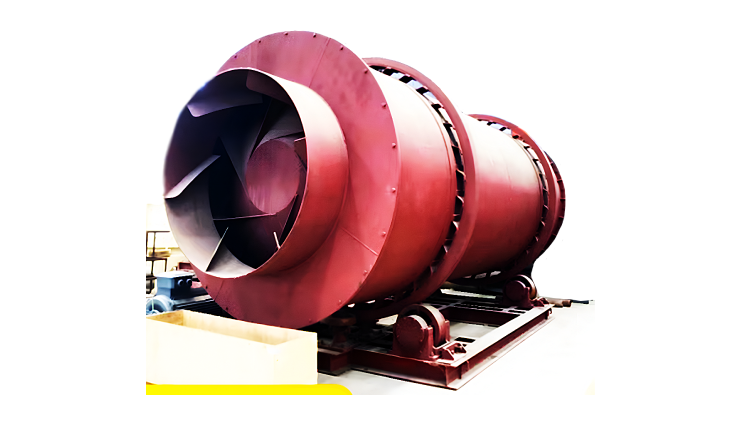
Wet feed material is made to shower continuously in a cascade manner in a stream of hot air, when moisture gets transferred to the air, rendering the product progressively dry as it travels the length of the dryer’s cylinder provided with suitable lifters. The humid air is exhausted via a dust collection system to trap any fines escaping with the exhaust air.
A Rotary Cascade Dryer is one of the most common and efficient types of direct-contact rotary dryers, widely used for drying granular, crystalline, or free-flowing materials such as minerals, fertilizers, sand, salts, and chemicals. It operates on the principle of direct heat transfer by convection, where hot gases come into direct contact with the wet material as it is tumbled and lifted inside a rotating drum fitted with internal lifters or flights.
The cascading motion of the material through the hot gas stream ensures intimate mixing, large surface exposure, and uniform drying. Moisture is removed rapidly, and the dried product is discharged continuously from the other end of the drum.
The working principle of a Rotary Cascade Dryer is based on direct contact heat transfer between hot air or gas and the wet solid material.
The cascade action ensures excellent contact between gas and solids, uniform drying, and efficient use of heat energy.
A Rotary Cascade Dryer mainly consists of the following components:
The core of the dryer is a long, horizontal cylindrical shell, slightly inclined (1°–5°) to the horizontal axis to facilitate gravity-assisted movement of material. The drum is fabricated from mild steel, stainless steel, or alloy steel depending on the product and process temperature.
The internal surface of the drum is fitted with lifting flights or blades arranged in rows along the circumference.
The wet material is introduced into the upper end of the drum through a feed chute or screw conveyor. The feed is distributed uniformly to prevent clogging and to ensure consistent cascading action inside the drum.
The drying medium — hot air or flue gas — is generated using:
The inlet air temperature typically ranges from 200°C to 800°C, depending on the product. The hot gases enter the drum either from the same end as the feed (co-current flow) or from the opposite end (counter-current flow).
There are two common airflow arrangements:
The moist air or exhaust gases exit through an outlet duct at the opposite end of the drum. The outlet is connected to dust collection equipment such as a cyclone separator, bag filter, or scrubber, which removes fine particles before venting the clean air to the atmosphere.
The dried material is continuously discharged through an outlet chute or screw conveyor at the lower end of the drum. The outlet often includes a seal arrangement to prevent air leakage.
The drum is rotated by an electric motor and reduction gearbox, connected through a chain, belt, or girth gear drive. The rotational speed can be varied using a variable frequency drive (VFD) to control the residence time of material inside the drum.
The entire outer surface of the drum is covered with thermal insulation (usually glass wool or mineral wool) and enclosed in a sheet metal casing to prevent heat loss and ensure operator safety.
The dryer is equipped with temperature sensors, airflow meters, and pressure gauges at the inlet and outlet. In modern systems, a PLC–HMI control panel is used for automatic regulation of air temperature, drum speed, and feed rate, ensuring consistent drying performance
continuous drying with stable performance.
low CAPEX and easy maintenance.
transfer from cascading curtains for fast drying.
high initial moisture, and abrasive feeds.
co-current or counter-current to suit the product.
via drum speed, slope, and flight pattern.
works with direct burners or waste/flue gas; heat recovery ready.
when paired with cyclones/bag filters.
with air results in uniform drying
capacities
drying
efficiency
demand
operation

































Unicoco, Indonesia was excited about the Coconut project, but through GEM we made this dream come true. GEM machines: dryers / screw conveyors / bleachers / graders, etc. they are absolutely good and require little maintenance. Also, we get 24×7 support from them in case we get stuck at any time.
GO FOR IT!!!
PT Unicoconut Industries Indonesia, Indonesia
Franklin Baker Company of the Philippines, in its continued effort to be the gold standard in processed coconut products, continues to partner with the best OEM suppliers for our manufacturing line requirements. One of them is GEM Forgings, which has been our trusted supplier of process equipment for our DC (desiccated coconut) dryers. We both value quality and service level in our business dealings.
Franklin Baker Company of the Philippines
Contact with us