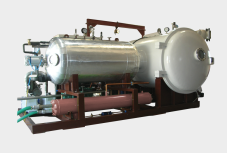
If you are looking for economical and cutting-edge solutions in freeze drying, you can stop your search at GEM. We are a pioneering freeze dryer manufacturer in India, delivering high-end lyophilizer technology machines. Our dryers are best suited for food and chemical applications.
The principle of freeze drying is based on the sublimation of ice — the direct conversion of water from the solid (ice) phase to the vapour phase without passing through the liquid state.
This process removes moisture from heat-sensitive materials such as biological products, pharmaceuticals, and food, while preserving their structure, nutrients, and volatile components.
A freeze dryer (lyophilizer) consists of several key components integrated to perform the three stages above under controlled conditions.
| Component | Function |
|---|---|
| Drying Chamber (Product Chamber) |
|
| Shelves / Trays |
|
| Refrigeration System |
|
| Vacuum System |
|
| Condenser (Cold Trap) |
|
| Heating System |
|
| Instrumentation and Controls |
|
| Product Containers |
|
of nutrients, enzymes, probiotics, flavors, and heat-labile actives
(high porosity, rapid wetting, low density, minimal shrinkage)
with low residual moisture and minimal oxidation (inert backfill)
via recipe control, data logging, and PAT tools
with CIP/SIP, sterile boundary, and stoppering for vials
no melting, scorching, or case hardening
liquids, purees, gels, crystals, sensitive biomolecules
wide temp range, fast ramp rates, uniformity mapping; bulk trays or vial handling
high hold-up and pull-down rate with hot-gas defrost for rapid turnaround
dry pumps, capacitance manometer & Pirani, pressure-rise/MTM endpoint checks
PLC-HMI/SCADA, recipes, batch reports, alarms,
SIP with clean steam, aseptic drain paths, FDA-compliant elastomers
redundant temp/pressure sensors, door interlocks, leak detection, vacuum break with sterile gas
automatic loading, vial stoppering, lyo caps, WFI/clean-steam utilities, remote diagnostics





























Unicoco, Indonesia was excited about the Coconut project, but through GEM we made this dream come true. GEM machines: dryers / screw conveyors / bleachers / graders, etc. they are absolutely good and require little maintenance. Also, we get 24×7 support from them in case we get stuck at any time.
GO FOR IT!!!
PT Unicoconut Industries Indonesia, Indonesia
Franklin Baker Company of the Philippines, in its continued effort to be the gold standard in processed coconut products, continues to partner with the best OEM suppliers for our manufacturing line requirements. One of them is GEM Forgings, which has been our trusted supplier of process equipment for our DC (desiccated coconut) dryers. We both value quality and service level in our business dealings.
Franklin Baker Company of the Philippines
Contact with us